Why Blazers Always Seem to Gap at the Waistband on an Hourglass Frame
Quick Answer: Most ready-to-wear blazers are cut with a straighter side seam that doesn’t account for a bust-to-waist difference as large as many hourglass frames have — the waist button strains and gaps because the jacket’s actual waist measurement is too wide relative to the bust it’s already buttoned around.
The shoulders fit, the bust closes fine, and then the single waist button pulls and gaps the moment you sit or move — a pattern-cut issue, not a sizing mistake on your part.

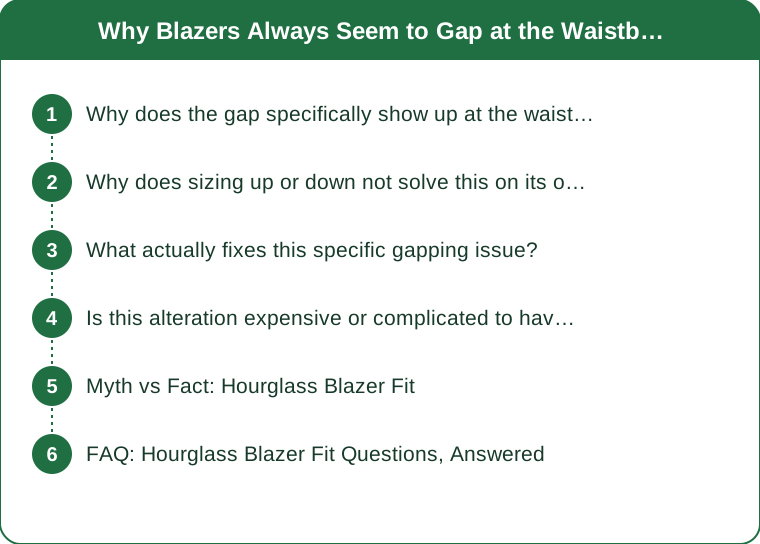
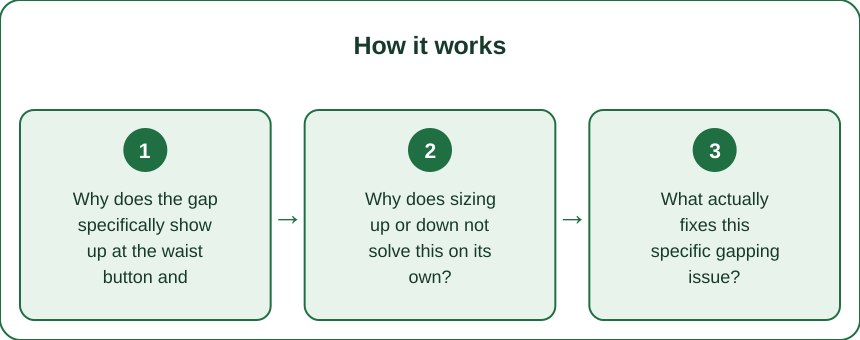
Why does the gap specifically show up at the waist button and nowhere else?
A standard blazer pattern is graded with a fairly modest difference between the bust and waist measurement. An hourglass frame’s actual bust-to-waist difference is often larger than that grading assumes, so by the time the jacket is sized to fit the bust and shoulders, the waist portion is cut too straight to actually follow the smaller waist underneath it.
Why does sizing up or down not solve this on its own?
Sizing up gives more waist room but adds even more excess at the shoulders and bust, which were already fitting correctly — sizing down does the opposite, tightening the bust and shoulders to try to match the waist. Either direction trades one fit problem for another rather than fixing the actual shape mismatch.
What actually fixes this specific gapping issue?
- A tailor taking in the side seams from bust to waist is the most direct fix, reshaping the jacket’s existing straight line into a real waist curve
- Brands offering a ‘curvy’ or ‘hourglass’ blazer cut build this curve in from the pattern stage, reducing or eliminating the need for alteration
- A single-button, more structured blazer generally shows the gap more obviously than an open, unstructured style, so style choice can reduce how noticeable the issue is even before alteration

Is this alteration expensive or complicated to have done?
Taking in a blazer’s side seams is one of the more routine, lower-cost tailoring alterations available, since it doesn’t require re-cutting collars, sleeves, or lining in a complex way — many alteration shops can turn this around within a few days at a modest cost relative to the blazer’s price.
Myth vs Fact: Hourglass Blazer Fit
Myth: A gapping blazer waist means you need a bigger size. Fact: Sizing up usually adds unwanted room at the bust and shoulders without actually fixing the waist curve issue.
Myth: This gap is a sign of buying a poor-quality blazer. Fact: It happens across many quality levels since it’s a pattern-grading assumption, not a construction defect.
Myth: Blazers just don’t work well for hourglass frames. Fact: A properly tailored or curvy-cut blazer fits this frame very well — the standard straight-cut pattern is the actual limitation.
FAQ: Hourglass Blazer Fit Questions, Answered
How do I know if a blazer needs tailoring versus just being the wrong size?
If the shoulders and bust fit well but the waist button strains or gaps, tailoring the side seams is usually the fix — if the shoulders themselves don’t fit, a different size or style is the better starting point.
Is it worth buying a blazer specifically labeled ‘curvy fit’?
Often yes for this frame specifically, since it’s cut with a larger built-in bust-to-waist difference that reduces or removes the need for later alteration.
Does this gapping issue happen with all blazer styles equally?
More structured, single-button styles tend to show it more visibly than looser, unstructured blazers, which drape rather than pull at one fixed closure point.
TL;DR:
- The waist gap comes from a pattern grading that underestimates bust-to-waist difference
- Sizing up or down trades one fit problem for another rather than fixing it
- Tailoring the side seams is a routine, relatively low-cost fix
- ‘Curvy fit’ blazers build the needed waist curve in from the start
A reshaped side seam, not a different size, is usually the real solution.
Keep Reading
This article is for general informational and styling purposes only. Fit, sizing, and product availability may vary.
