Why Hourglass Bodies Break Standard Size Charts
Quick Answer: Standard size charts assume a fairly consistent difference between bust, waist, and hip measurements (often around 8-10 inches bust-to-waist and waist-to-hip). A pronounced hourglass shape, with a larger differential, doesn’t map cleanly onto that assumption — which is why the size that fits your hip often gapes at the waist, and the size that fits your waist is tight through the bust and hip.
If you’ve ever needed to buy a top in one size and a bottom in a completely different one just to match your own proportions, that’s not an inconsistency in your body — it’s a mismatch between your proportions and the ratio most size charts assume.

Why does this specific body type break standard grading so often?
Most size charts use a fixed differential between bust, waist, and hip — increasing all three by a consistent amount as sizes go up — which works reasonably well for bodies whose own differential is close to that standard ratio. A pronounced hourglass shape has a larger-than-average differential, meaning no single size on a standard chart can simultaneously match all three measurements.
This is a mathematical mismatch in how grading systems are built, not a body “in between sizes” in the way that phrase usually implies — the body’s proportions are internally consistent, it’s the chart’s assumed ratio that doesn’t match.
What actually works for a pronounced hourglass shape?
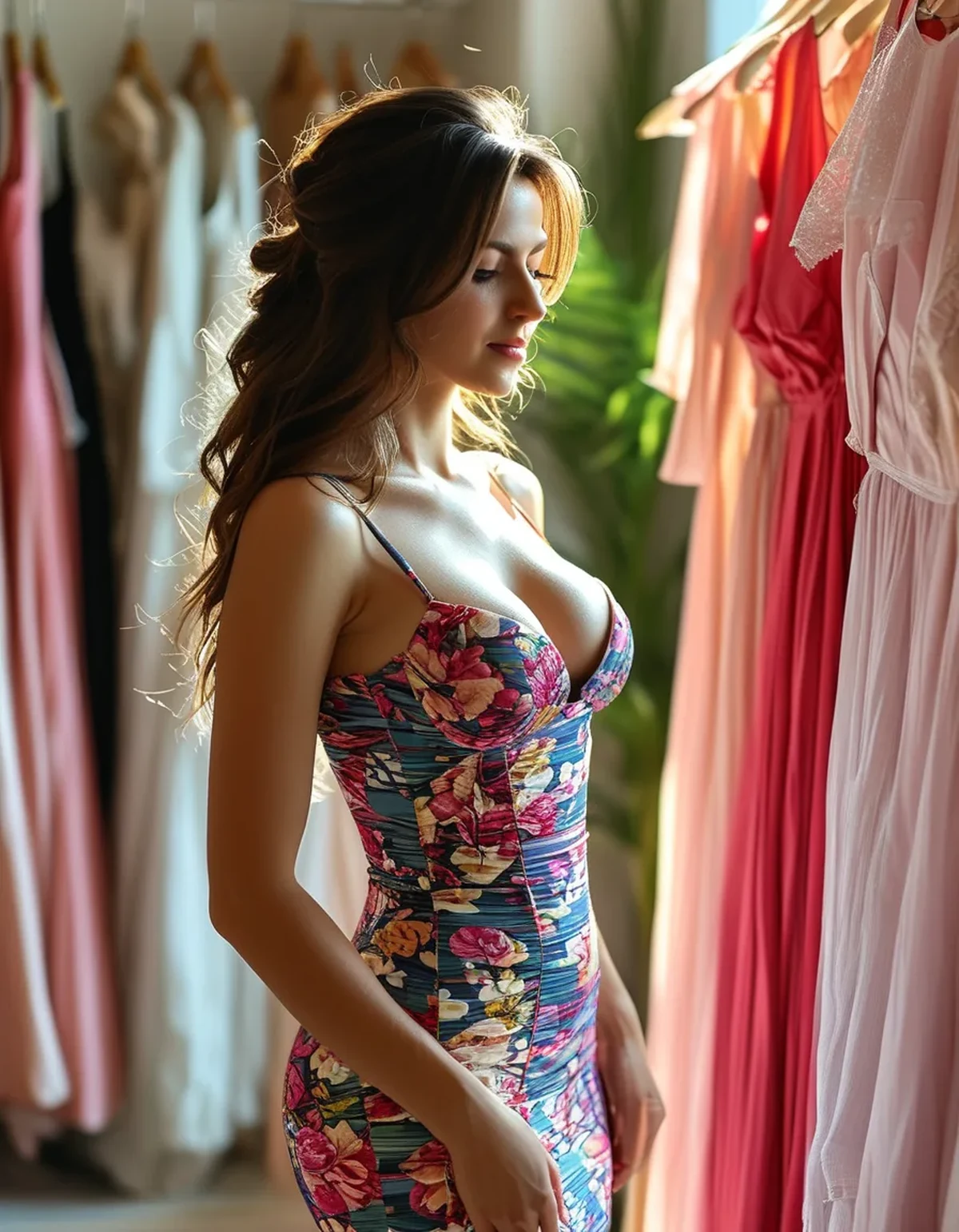
Garments with built-in shaping or adjustability — wrap styles, cinched or adjustable waistbands, stretch panels at the waist — accommodate a larger bust-to-waist-to-hip differential better than rigid, single-measurement garments. Separates (buying tops and bottoms independently rather than matched sets or dresses) also sidestep the problem structurally, since it lets each half fit its own measurement rather than a single averaged size.
A small number of brands now specifically design and grade for an hourglass ratio as a distinct fit category, rather than assuming one standard differential across their whole size range — worth searching for by name if this is a recurring fit issue across multiple brands.
FAQ: Hourglass Fit Questions, Answered
Is it better to size for my bust, waist, or hip when I can only pick one?
This depends on the garment — for tops, sizing to bust and planning for waist alteration or a wrap/tie style is common; for dresses, sizing to the largest measurement and tailoring down is usually easier than the reverse.
Do stretch fabrics solve this problem on their own?
They help significantly, but stretch alone doesn’t replace actual shaping — a stretch fabric in a poorly-shaped pattern can still fit unevenly across a pronounced differential.
Are separates really more reliable than dresses for this body type?
Generally yes, specifically because they let each measurement be sized independently rather than relying on one garment to match three different proportions at once.
TL;DR:
- A pronounced hourglass shape has a bust-to-waist-to-hip differential larger than most size charts assume
- This is a mismatch in the chart’s ratio, not inconsistency in the body’s own proportions
- Shaped or adjustable garments (wrap styles, cinched waists) accommodate this better than rigid single-measurement pieces
- Separates let each half of an outfit be sized to its own measurement independently
The fit problem isn’t your proportions being unusual — it’s a grading assumption that was never built to flex for a bigger differential in the first place.
Keep Reading
This article is for general informational and styling purposes only. Fit, sizing, and product availability may vary.
