How To Shop Matching Sets When Your Top and Bottom Sizes Differ
Quick Answer: Buy the two pieces separately whenever the brand allows it, even when the set is sold as a bundle, because the price difference is usually small and the fit difference is large. When you cannot, size to the bottom and manage the top, since leggings have far less tolerance for being wrong than a top does. And check whether the brand sells the pieces in the same colorway individually, which many do without advertising it, because that single question solves the problem outright most of the time.
The set looks perfect on the model. You order your size. The leggings fit and the top gapes, or the top fits and the waistband cuts.
This is not a sizing mistake. A matching set assumes your top and bottom are the same size on the same chart, and on an hourglass frame with a two-size difference between bust and hip, that assumption was never going to hold.

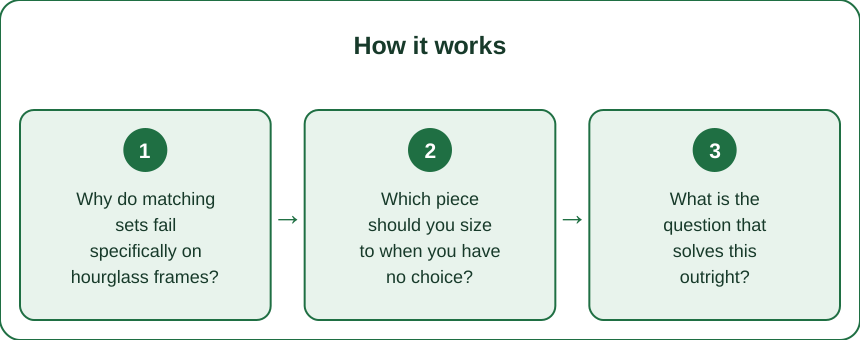
Why do matching sets fail specifically on hourglass frames?
Because a set is graded from a single body model, and a single body model has one bust-to-waist-to-hip ratio.
Standard grading assumes a roughly consistent relationship between measurements. Go up a size and all three measurements increase together, in a fixed proportion.
An hourglass frame breaks that in a specific way: the bust and hip are both substantially larger relative to the waist than the grading assumes. So on a chart, your bust might read a 12, your waist an 8, and your hip a 12.
A set sold in one size cannot accommodate that. Buy the 12 and the waist floats. Buy the 8 and the bust and hip are wrong. There is no correct answer within the set.
Why it feels worse than buying separates: with separates, you have already accepted that you buy two sizes. With a set, the packaging promises one, so the failure feels like a fit problem rather than a math problem.
Which piece should you size to when you have no choice?
Size to the bottom, almost always.
The reasoning is about tolerance. Leggings and shorts have a narrow window in which they work. Too small and the waistband digs, the fabric goes sheer under stretch, and the rise sits wrong. Too large and they slide down during movement, which is worse than uncomfortable, it is unusable.
Tops have a much wider tolerance. A slightly large top is a relaxed top. A slightly small top in a stretch fabric is a fitted top. Both are wearable. Only at the extremes does a top become genuinely wrong.
The exception is a top with built-in support. A bra-integrated top or a fitted crop with a shelf has bottom-like tolerance, not top-like tolerance. If the set includes one, this rule reverses and you have a real problem, which is the argument for buying separates.
Practical version: for a set with a loose or semi-fitted top, size to your bottom size and expect the top to run snug or loose depending on your direction. For a set with a supportive top, do not buy the set.
What is the question that solves this outright?
Ask whether the brand sells the pieces individually in the same colorway.
Many brands that market sets also list the pieces separately, in the same fabric and colorway, and simply do not connect the two on the site. The set exists as a merchandising bundle, not as a manufacturing one.
How to check:
- Search the site for the colorway name rather than the set name
- Look at the individual leggings and bra or top categories for the same fabric
- Check whether the set page has a small line about pieces sold separately, often below the fold
- Ask customer service directly, which resolves it in one message
The price difference is usually 5 to 15 percent over the bundle price, which is a small premium for two pieces that both fit.
When the answer is no, you are choosing between the size-to-the-bottom compromise and skipping the set. Skipping is a legitimate answer. A set where one piece does not fit gets worn as separates anyway, which was the outcome you were trying to avoid.
5 Mistakes Everyone Makes Buying Sets
1. Ordering one size and planning to exchange. Exchanges on sets are frequently all-or-nothing, so you cannot swap only the top. Order two full sets in different sizes if the return policy allows, keep the pieces that fit, return the rest.
2. Assuming the set uses the brand’s normal size chart. Sets are often graded on a different block from the brand’s core line, particularly when they are seasonal drops. Check the specific product measurements, not the site-wide chart.
3. Buying a set with an integrated-support top. This is where the compromise stops working, because both pieces now need to be correct. Sets with a plain top are far more forgiving.
4. Ignoring the fabric’s stretch percentage. A set with 20 percent elastane accommodates a size difference far better than one at 8 percent. The elastane content is usually listed and it is genuinely predictive.
5. Judging fit while standing still in a fitting room. For a bottom, squat. For a top, raise your arms overhead and hold. A set that fails either of those will fail in a class.
The fourth one is the most useful and the least known. Two sets that look identical can behave completely differently, and the composition line tells you which is which before you order.
What actually works for building coordinated outfits instead?
If sets keep failing, the practical answer is to build the look from separates deliberately.
Match by fabric family, not by exact colorway. Two black pieces in the same fabric weight read as a set even if they came from different products. Two pieces in slightly different blacks read as a mistake. Fabric consistency matters more than color precision.
Anchor on neutrals. Black, deep navy, and charcoal coordinate across products and seasons. Seasonal colors do not, and they are usually the ones sold exclusively as sets.
Buy the bottom first, in your bottom size, and build up. Bottoms have narrower tolerance and shorter availability windows. Tops can be matched later.
Keep a note of what worked. Write down the brand, the product, and the size for each piece that fits well. Hourglass sizing is enough of a project that a running list saves real time, and it makes reordering trivial when a piece wears out.
A seasonal note: as fall arrives, sets shift toward heavier fabrics and layering pieces, often with lower elastane content. Lower stretch means less tolerance for a size mismatch, so the fall set is generally a worse candidate for the compromise approach than the summer one was. Buy separates through the transition, or wait for the pieces to be listed individually, which usually happens a few weeks after a set drops.
FAQ: Matching Set Sizing Questions, Answered
Should I size up or down for a matching set?
Size to your bottom half. Leggings have a much narrower window in which they work, while a top that runs slightly snug or loose is still wearable.
Can I buy the pieces of a set separately?
Often yes, even when the site only shows the bundle. Search the colorway name in the individual categories, or ask customer service. The premium is usually 5 to 15 percent.
What if the set has a built-in bra top?
Skip the set. A supportive top needs to fit as precisely as the bottom does, which removes the compromise that makes sets workable on an hourglass frame.
TL;DR:
- Sets are graded from one body with one bust-waist-hip ratio, which is the ratio an hourglass frame does not have.
- Buy the pieces separately whenever possible. Many brands list them individually without advertising it.
- When you cannot, size to the bottom. Leggings have a narrow tolerance; tops have a wide one.
- Skip any set with an integrated-support top, because both pieces then need to be exactly right.
- Check the elastane percentage. Higher stretch absorbs a size difference; fall’s lower-stretch fabrics do not.
The set was not designed for your proportions and no size in it will be. Buying two sizes is not a compromise, it is the correct purchase.
See It in Motion
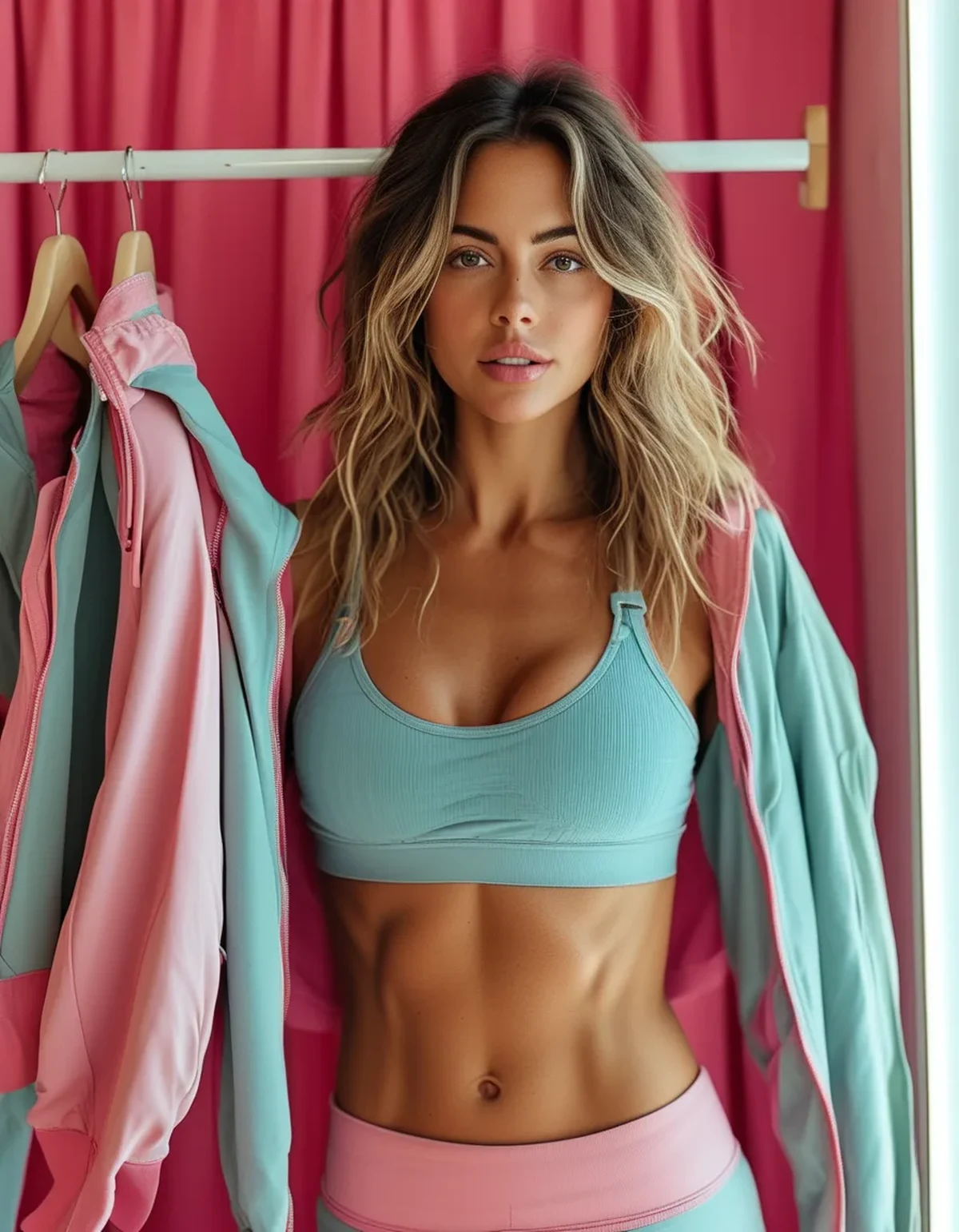
Seen here: High Waist Yoga Leggings with Inner Pocket — shop it on bubblelime.com
Keep Reading
This article is for general informational and styling purposes only. Fit, sizing, and product availability may vary.
