Why Do Hourglass Bodies Struggle More With Activewear Than Any Other Shape?
Quick Answer: Standard activewear sizing is built around a single measurement gradient (usually the waist), but hourglass proportions have a bigger gap between waist and hip/bust than that gradient accounts for — so a size that fits your waist gaps at your hip, and a size that fits your hip is loose at your waist.
You’re not imagining it, and you’re not ‘hard to fit’ as a personal quirk — hourglass proportions are mathematically harder for standard sizing systems to serve than straighter body shapes, and here’s exactly why.
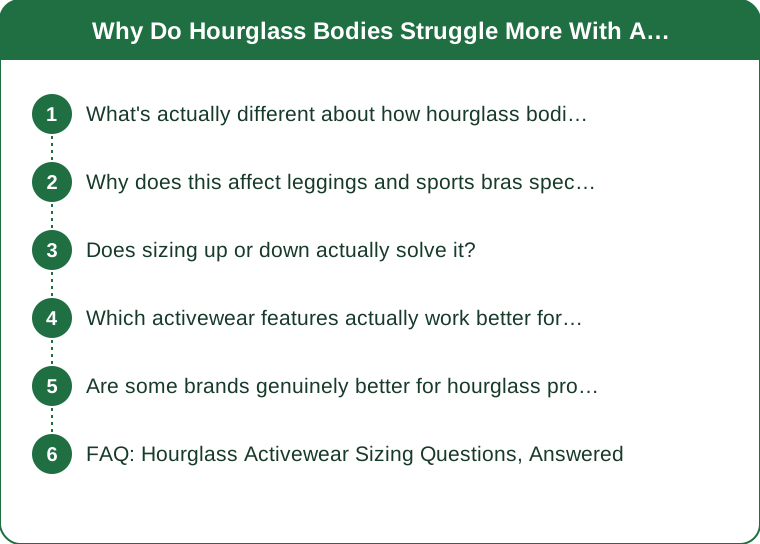
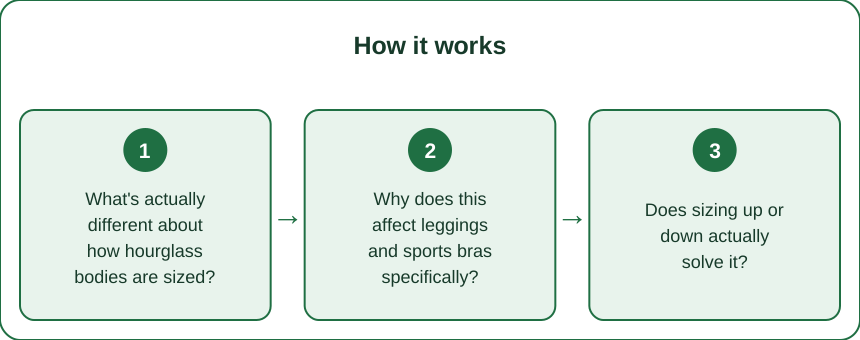
What’s actually different about how hourglass bodies are sized?
Most activewear size charts are built on a single proportional ratio between waist, hip, and bust that assumes a relatively consistent difference between measurements as sizes go up. Hourglass proportions typically have a larger-than-average gap between waist and hip/bust — often 9-10+ inches versus a size chart’s assumed 7-8 inch gap. That extra few inches doesn’t disappear; it shows up as either a gaping waistband (sized for hip) or a digging waistband (sized for waist), because the garment was patterned for the smaller gap.
Why does this affect leggings and sports bras specifically?
Leggings and high-waisted bottoms are the worst offenders because the waistband has to simultaneously accommodate the smaller waist measurement and stretch over the larger hip measurement while staying snug at both — a straighter body shape asks much less of that same fabric. Sports bras face a related issue: band sizing assumes a certain ratio to bust size, and a fuller bust on a smaller frame (common in hourglass proportions) frequently needs a smaller band with a larger cup than standard size charts offer as a single number.
Does sizing up or down actually solve it?
Rarely cleanly. Sizing up to fit the hip usually means excess fabric bunching at the waist and loose material through the midsection that undermines both look and function during movement. Sizing down to fit the waist usually means genuine discomfort and restricted movement at the hip, plus visible fabric strain that shortens the garment’s lifespan. This is why so many hourglass-shaped people report owning activewear in two different sizes for the ‘same’ size — one honest reflection of the sizing gap, not inconsistency in the brand.
Which activewear features actually work better for hourglass proportions?
Separates over sets — buying tops and bottoms independently sized rather than matching sets lets each piece fit its own measurement. Wide, high-rise waistbands with 4-way stretch handle the waist-hip gap better than narrow or low-rise bands, which have less fabric to work with across the difference. For bras, brands offering true band/cup sizing (like separate band and cup numbers, similar to bra sizing logic) fit hourglass chests far better than one-size-covers-a-range sports bras.
Are some brands genuinely better for hourglass proportions than others?
Yes, and the difference usually comes down to whether a brand designed around a single size-gradient assumption or built patterns accounting for a wider range of waist-hip ratios. Brands that offer curve-specific or ‘contour’ fit lines within their size range — rather than just scaling one pattern up and down — consistently fit hourglass proportions better, because they’re solving for the actual gap rather than assuming it away.
FAQ: Hourglass Activewear Sizing Questions, Answered
Why do my leggings fit at the hip but gap at the waist?
The garment was patterned for a smaller waist-hip gap than your actual proportions — sizing up for the hip leaves excess room at the smaller waist measurement.
Should hourglass body types buy separates instead of matching sets?
Generally yes — independently sized tops and bottoms let each piece fit its own measurement rather than compromising both to match a single labeled size.
Do any activewear brands size specifically for hourglass proportions?
Some do, usually labeled as curve-fit or contour lines rather than standard sizing. Checking a brand’s actual size chart ratios (waist-to-hip difference) before buying is more reliable than trusting size labels alone.
TL;DR:
- Hourglass proportions often have a 9-10+ inch waist-hip gap versus a size chart’s assumed 7-8 inches
- That gap shows up as gaping or digging waistbands, not a garment quality issue
- Buying separates instead of matching sets lets each piece fit its own measurement
- Wide high-rise waistbands and true band/cup sports bras fit the gap better than standard sizing
The fit struggle isn’t about being hard to dress — it’s a real gap between how sizing systems are built and how hourglass proportions actually measure.
See It in Motion
Seen here: High Waist 8” Yoga Shorts — shop similar styles on bubblelime.com
Keep Reading
This article is for general informational and styling purposes only. Fit, sizing, and product availability may vary.
