Why Your Tops Ride Up Over Your Hips and Refuse to Stay Down
Quick Answer: Tops ride up on hourglass frames because most are cut with a straight or slightly A-line body and not enough hip circumference relative to the waist. When the hem has to stretch over a hip measurement it was not drafted for, the fabric takes the path of least resistance and travels upward to the narrower waist. The fixes are more hem width, more stretch, longer length, or a tuck that removes the problem entirely.
You buy the size that fits your bust. It rides up.
You buy the size that fits your hips. It rides up and now it gapes at the waist.
Neither size is wrong. The shape is.

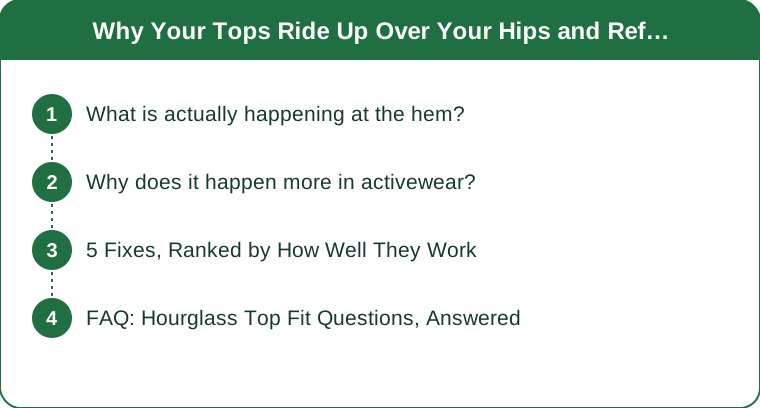
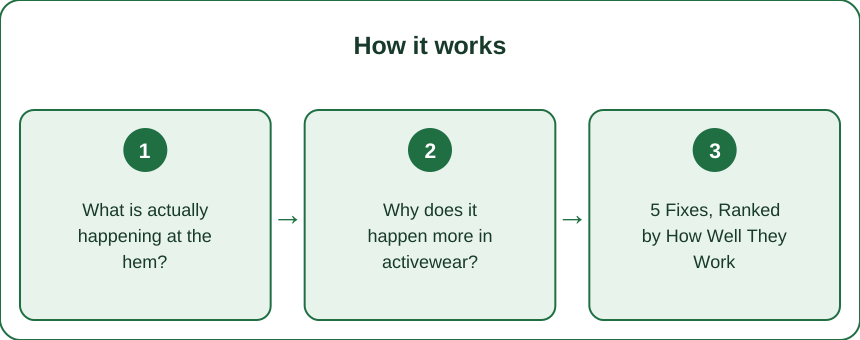
What is actually happening at the hem?
Fabric moves to where it is under the least tension, and on an hourglass frame that direction is up.
A hem stretched over the hip is under tension. If the top’s hem circumference is smaller than your hip measurement, the fabric must stretch to pass over it. Stretched fabric holds elastic energy and will move to relieve it.
Directly above the hip is a much narrower waist. The waist offers a lower-tension resting place, and every movement — reaching, sitting, walking — gives the fabric a small opportunity to travel there. Once it arrives, nothing pulls it back down.
The waist-to-hip difference is the specific variable. A frame with a small difference between waist and hip means the hem has less far to travel and less tension to relieve. A large difference — which is what defines an hourglass shape — creates both a steeper gradient and more stretch at the hem.
Sizing up does not fix it, and often makes it worse. A larger size adds circumference everywhere, so now the shoulders and bust are loose, there is excess fabric at the waist, and that excess bunches — which gives the hem even more encouragement to climb.
Straight-cut tops are the worst offenders. A top drafted as a straight tube from underbust to hem assumes minimal difference between waist and hip. On an hourglass, that tube fits at the widest point and hangs loose everywhere else, or fits at the waist and rides at the hip.
Why does it happen more in activewear?
Because activewear amplifies both sides of the problem.
Stretch fabric relieves tension by moving. Woven fabric that does not fit simply feels tight and stays put. Knit and stretch fabric can travel, and it will. This is why a stiff cotton shirt sits still and a soft jersey tee climbs.
Movement is continuous. Every rep, reach and rotation gives the hem another chance to shift, and unlike everyday wear, nobody stops to adjust mid-set.
Compression tops grip and then release. A compressive fabric grips at the narrowest point it can find and holds there, which happens to be your waist. This is why a firm compression top can be the worst riding-up offender despite feeling secure when you put it on.
Cropped and mid-length cuts have less anchor. A hem sitting just above or at the hip has the shortest journey to the waist. A longer top has more length below the hip acting as ballast, which is why longline styles often stay put where mid-length ones do not.
High-rise leggings interact with it. A high waistband that ends exactly where the top’s hem sits creates a slippery interface at the widest point of contact, and the two garments push against each other with every movement. Staggering where the two hems sit — one clearly above or below the other — reduces the fight considerably.

5 Fixes, Ranked by How Well They Work
1. Buy longline or tunic lengths. A hem sitting well below the hip has ballast and a much longer distance to travel. This is the most reliable structural fix, and it works even when the fit is imperfect elsewhere.
2. Look for a curved or shirttail hem. A hem cut with extra length at the sides and back adds circumference exactly where the hip needs it, without adding bulk at the front. It is the single most effective drafting feature for this problem, and it is easy to spot on a hanger.
3. Choose fabric with genuine four-way stretch and good recovery. Two-way stretch fabric stretches horizontally and cannot recover vertically, so once it moves up it stays. Four-way stretch with good recovery pulls itself back down.
4. Tuck it, or use a half tuck. The fastest fix available. A front tuck into a high waistband eliminates the hem’s ability to travel while keeping the back long, and it also creates a defined waist rather than fighting for one.
5. Stagger the hems with your bottoms. If your top’s hem lands exactly at your waistband, move one of them. A longer top over a high-rise waistband, or a shorter top well above it, both work. What fails is two hems meeting at the same line on the widest part of your torso.
Bonus: check the side seam. A top with a side seam that curves outward below the waist is drafted for a waist-hip difference. A dead-straight side seam is not, and no amount of sizing will change that.
FAQ: Hourglass Top Fit Questions, Answered
Should I buy for my bust or my hips?
Buy for the bust and look for hem shape and stretch to handle the hip. Buying for the hip gives you a top that is loose everywhere else and still rides up because of the excess fabric.
Do longer tops make me look larger?
Generally no — a longline top over a fitted bottom creates a clean vertical line. What reads as bulk is a hem sitting bunched at the waist, which is what riding up produces.
Why does the same size work in one brand and not another?
Brands draft to different fit models with different waist-to-hip ratios. Once you find a brand whose block matches your shape, staying with it saves an enormous amount of time.
Are matching sets worse for this?
Often yes, because the top and bottom hems are designed to meet, which puts two hems at the same line. Sets sized separately for top and bottom work far better.
Does a bodysuit solve it?
Completely, and it is why bodysuits are popular with hourglass frames. The trade-off is the obvious practical one, so most people keep a few rather than switching entirely.
Will altering help?
Taking a top in at the waist makes riding up worse, not better, because it increases the tension differential. Adding hip room is difficult on most knits. Buying the right shape is a better use of money than altering the wrong one.
TL;DR:
- Hems ride up because they are stretched over the hip and travel to the lower-tension waist above it.
- Sizing up does not fix it — it adds bunching, which makes it worse.
- Look for curved or shirttail hems, longline lengths, and four-way stretch with real recovery.
- Stagger your hems — a top hem meeting a waistband at the widest point is a guaranteed fight.
- A straight side seam means the top was not drafted for a waist-hip difference. Check it on the hanger.
Once you know what to look for on a hem, the changing room stops being a guessing game.
Keep Reading
This article is for general informational and styling purposes only. Fit, sizing, and product availability may vary.
